
The Crucible of Force: Validating Tool Integrity
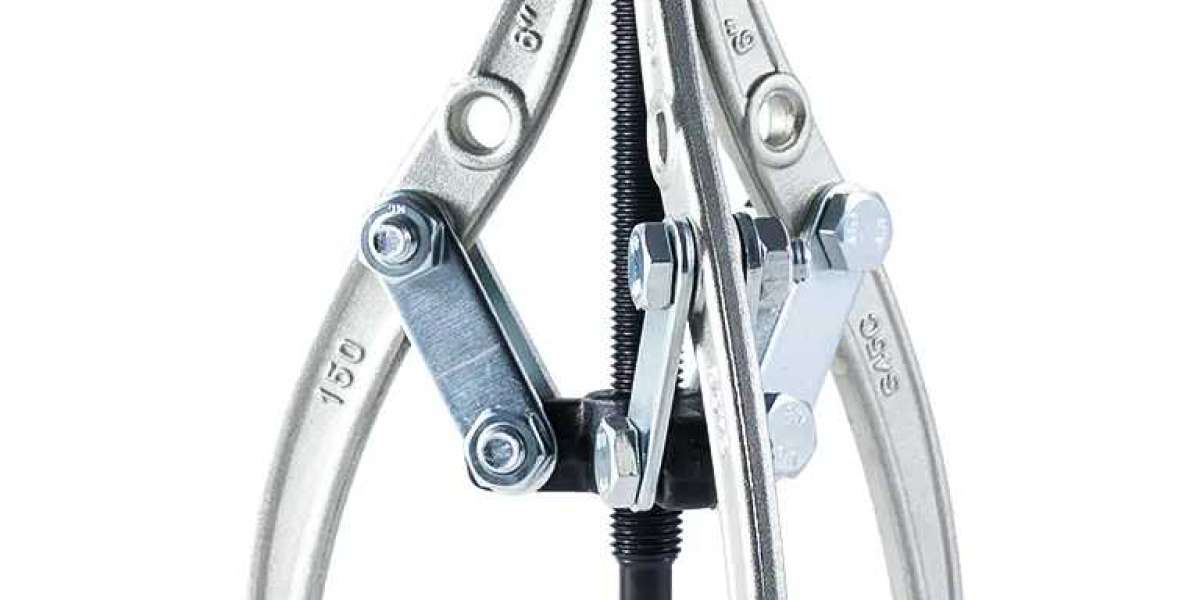
For a professional tool manufacturer, the true measure of quality is not found in a catalogue specification, but in a product's performance at its breaking point. This is especially critical for components like gear pullers, where failure under load can cause catastrophic damage to equipment and pose severe safety risks. Therefore, a rigorous gear puller factory implements a multi-layered testing regime designed not just to check dimensions, but to simulate and exceed the extreme stresses encountered in real-world applications, ensuring every tool that leaves the line possesses a known and reliable safety margin.
Destructive Testing: Establishing the Ultimate Safety Margin
The foundation of this regime is destructive testing, conducted on a statistical sample from each production batch. This involves mounting a puller in a calibrated hydraulic tensile testing machine. Force is applied steadily and linearly, far beyond the tool's rated capacity, until the component physically fails—whether by the jaw cracking, the screw shearing, or the yoke deforming. The exact force at failure is meticulously recorded. This data is used to calculate the tool's actual safety factor. For instance, if a puller rated for 10 tons fails at 40 tons, it confirms a 4:1 safety factor. This process validates the entire production chain: material grade, heat treatment, forging integrity, and machining quality. It provides empirical proof that the design and manufacturing processes consistently yield a product with a substantial buffer against unpredictable field conditions, such as seized components or uneven force application.
Cyclic Fatigue Testing: Simulating a Career of Use
A single massive pull rarely causes failure; more often, it is the cumulative effect of repeated use. To assess this, factories perform cyclic fatigue testing. A puller is mounted in an automated rig that repeatedly applies a dynamic load—typically between 50% to 80% of its rated capacity—for thousands of cycles. This simulates years of professional use. Engineers monitor for signs of "metal fatigue": the initiation and propagation of microscopic cracks. This test is crucial for evaluating critical stress points like the jaw roots, the thread engagement zones on the forcing screw, and the pivot pins. A tool that passes high-cycle fatigue testing demonstrates not just strength, but resilience and longevity, assuring users it won't develop sudden, catastrophic flaws after repeated jobs.
Functional Application Testing: The Real-World Benchmark
The final layer of validation is functional application testing, conducted in a controlled workshop environment. Technicians use production-line pullers on purpose-built test rigs featuring intentionally seized bearings or gears mounted on hardened shafts. These tests evaluate the complete system performance under realistic, often suboptimal, conditions. Key metrics include:
Jaw Integrity: Checking that the claws do not slip, deform, or chip under high side load.
Screw Performance: Ensuring the forcing screw moves smoothly without binding or cross-threading, even when subjected to off-center loads.
Stability Alignment: Verifying that the entire assembly remains stable and does not "cock" or jump dangerously as pressure increases.
Any tool that successfully passes this gauntlet of simulated abuse—from calculated destruction and repetitive fatigue to practical, high-friction application—earns its certification. This comprehensive approach transforms quality control from a passive inspection into an active proving ground, where the tool’s mettle is tested against the very forces it is designed to conquer.